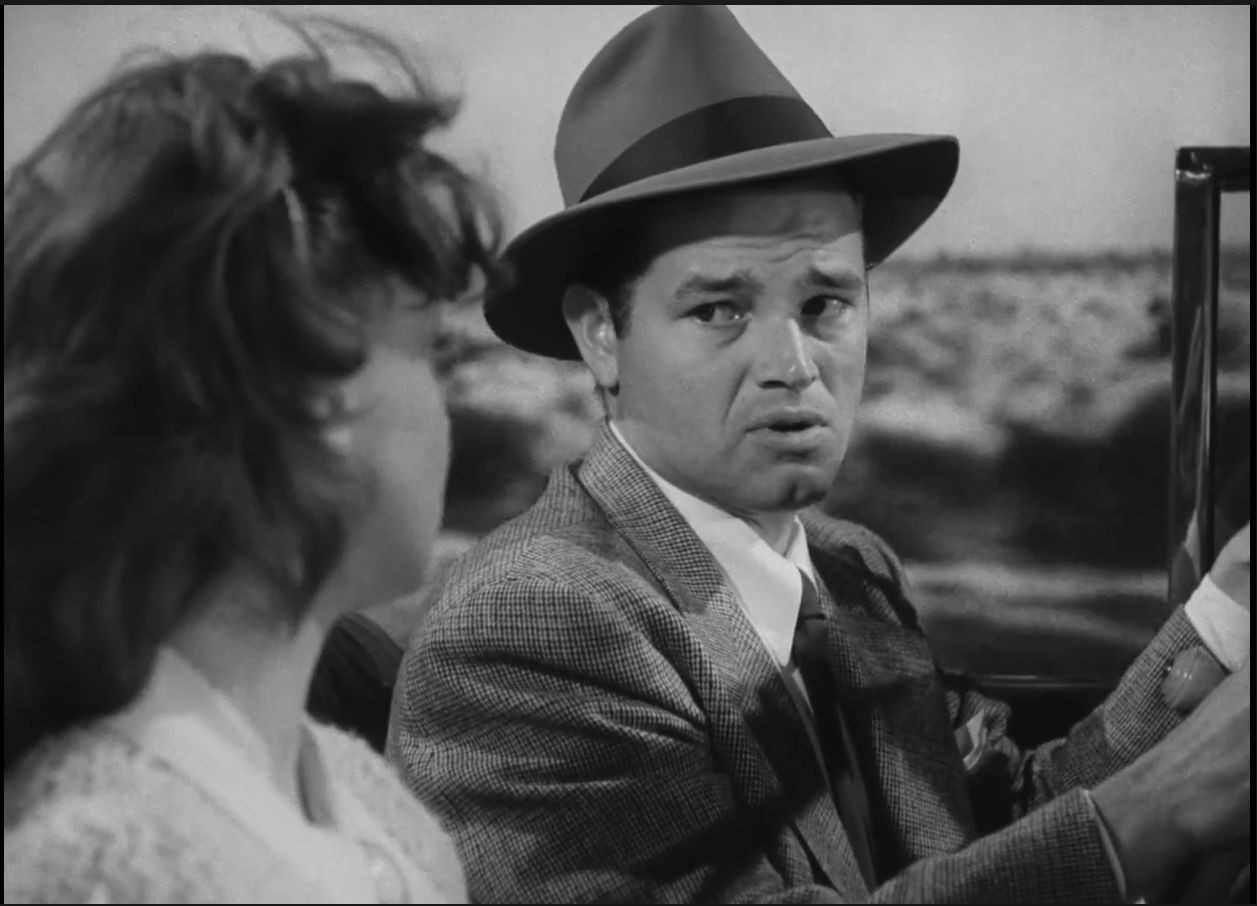
The Stolen Studio Buick
To save time and money, director Edgar G. Ulmer “borrowed” his wife’s private luxury car—a 1941 Buick—for the shoot without telling the producers. This is the main car you see in the movie. Since Ulmer had zero budget for insurance or permission to use private property on a commercial set, the entire crew had to film the driving scenes in absolute secrecy, praying that none of the actors would scratch the paint.
Ann Savage’s Ruined Wardrobe
Actress Ann Savage wore her own private clothes in the film because the wardrobe budget for her character was exactly zero dollars. The director wanted Vera to look completely exhausted and filthy from traveling. He ordered Savage not to wash her clothes for the entire duration of the shoot and to sleep in them between takes. By the end of production, her silk blouse and skirt were so ruined by sweat and technical smoke that they had to be thrown away.
The Mirror Image Nightmare
During editing, Ulmer realized he made a fatal directorial mistake: in key driving scenes, the car was moving in the wrong geographical direction against the rear-projection screen. Instead of reshooting, the editor simply flipped the film strip 180 degrees to create a mirror image. If you look closely in several driving scenes, the steering wheel is suddenly on the right side of the car, and Tom Neal is pretending to shift gears with his left hand.
Music from the Public Domain
The studio didn’t have a single dollar to pay a composer for an original score. Ulmer, who had a strong background in classical music, personally searched the studio’s music archives and picked tracks that were already in the public domain. Because of this, this dark crime film is scored with modified themes from Frédéric Chopin. Using classical compositions in such a gritty movie created an incredibly unsettling atmosphere.
The Fake New York Rain
The opening scene in New York, where Al Roberts walks through a heavy downpour, was shot behind a cheap hangar at night. Since the studio didn’t own professional rain machines, two crew members stood on ladders just outside the frame with regular garden hoses hooked up to a fire hydrant. The water was so freezing cold that Tom Neal developed hypothermia, and the director had to warm him up with alcohol between takes so the actor would stop shivering on camera.
Q: Is it true that Detour was shot in less than a week?
A: Almost. The director, Edgar G. Ulmer, managed to shoot the entire movie in just six days. Because they had virtually no money, the crew worked brutal 18-hour shifts, and most of the scenes inside the car were filmed on a tiny indoor stage with a cheap projector rolling a fake highway background behind the actors.
Q: Did the main actor really get into deep trouble in real life too?
A: Ironically, yes. Tom Neal’s real life was just as messy and tragic as his character’s fate in the movie. Years after this film, his acting career completely collapsed after he got into a brutal Hollywood fistfight over a woman, and in 1965, he was actually convicted of involuntary manslaughter for shooting his third wife.
Q: Why does the movie look so incredibly foggy and dark?
A: It wasn’t a stylistic choice at first—it was a desperate trick to hide the cheap sets. The studio couldn’t afford realistic outdoor locations or proper background props, so Ulmer ordered the crew to fill the entire stage with heavy, artificial smoke. It cost almost nothing and perfectly hid the fact that they were shooting in an empty room.
Q: Who was Ann Savage and why was her performance so shocking?
A: She played Vera, and she completely flipped the traditional “femme fatale” trope on its head. Instead of being a glamorous, seductive lady, she played Vera as a vicious, coughing, bitter hitchhiker who treats the main character like garbage. American audiences in 1945 had never seen a woman act that nasty on screen.
Q: How did they manage to get away with the accidental murder scenes?
A: Hollywood censors in the 1940s had a strict rule: criminals always had to be punished by the law at the end. To bypass this, the director added a final, depressing scene where the main character imagines getting picked up by a police car. It satisfied the censors while keeping the gritty, hopeless vibe of the movie intact.